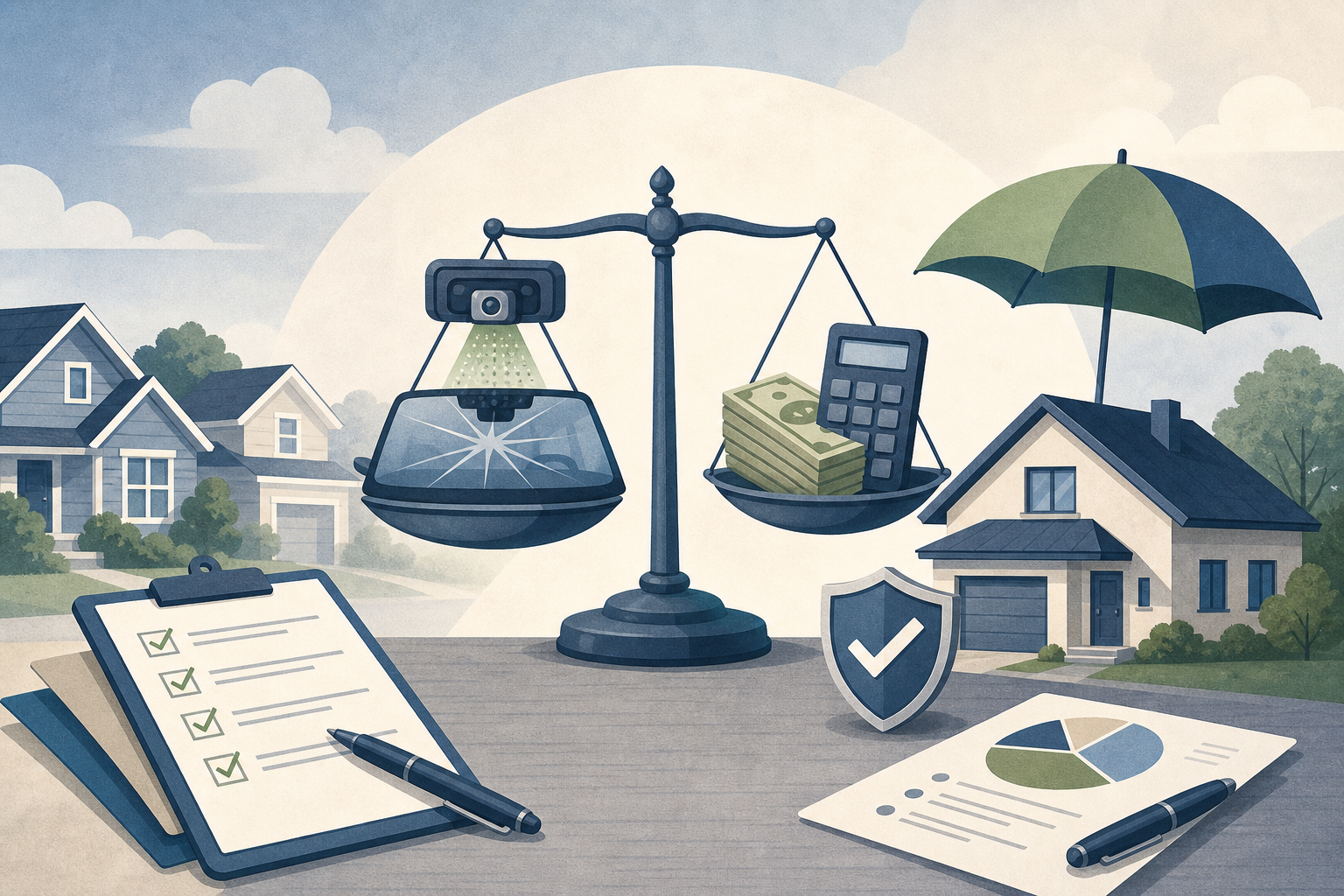
Why does windshield replacement cost so much now?
A rock kicks up off a truck tire, taps your windshield, and a week later the crack has crawled six inches across your sightline. You call a glass shop expecting the number you remember from your last car. Instead you get a quote for $1,400, maybe $1,800, and a line item you have never seen before: calibration.
You are not being overcharged. You are paying for the fact that your windshield is not just glass anymore.
Right now, at the tail end of a summer that sent a lot of road debris and hail your way, this exact surprise is landing on a wave of drivers. If it just landed on you, here is what that calibration line means and the arithmetic that tells you whether to file a claim or just pay it.
What is ADAS and why does it live in your windshield
ADAS stands for advanced driver assistance systems. That is the lane-keeping alert that nudges your wheel back into the lines, the automatic braking that stops you before you tap the car ahead, the adaptive cruise control that slows down when traffic does. Most of that hardware, especially the camera, is mounted right behind your windshield glass, usually near the rearview mirror.
That camera has to be aimed with real precision. It is reading lane markings and judging distance to the car in front of you, sometimes at highway speed. When a shop pulls out your old windshield and sets a new one, the camera comes off and goes back on in a slightly different spot every time. Off by even a little, and the system might brake later than it should, or not read a lane line at all.
Calibration is the process of pointing that camera back to exactly where it needs to be. Some shops do it with a target board and a tape measure in a controlled bay (static calibration). Some do it by driving the car on the highway while a scan tool watches the camera relearn the road (dynamic calibration). Some jobs need both. None of it existed as a line item on a windshield quote back when your last car had one job to do: keep the wind off your face.
That is the whole story behind the jump. It is not that glass got more expensive. It is that your windshield now has a computer attached to it, and that computer needs a checkup every time the glass changes.
Who profits when your quote looks scary
Here is the part nobody says out loud. A carrier does not benefit from your windshield being cracked. A carrier benefits from you filing a claim about it. Those are two different events, and the size of the bill is what pushes people from one to the other.
A $300 chip repair feels like something you shrug off and pay yourself. A $1,900 replacement with calibration feels like exactly the kind of thing insurance is for, so people reach for the phone. But filing is what puts a claim on your CLUE report for the next seven years. Filing is what can trigger a premium surcharge. Filing is what can cost you your claims-free discount, sometimes for years. None of that is triggered by the size of the job. It is triggered by the act of filing, whether the bill is $300 or $3,000.
A bigger number on the quote does not change what filing costs you behind the scenes. It just makes filing feel more urgent. That urgency is doing work for the carrier's bottom line, not yours.
The should-I-file math, with the ADAS cost folded in
Here is the comparison that actually matters, the same one behind the calculator: full repair cost, including calibration, against your deductible, plus what filing will cost you in surcharge and lost discount.
Say your windshield and calibration quote comes to $1,900. Your deductible is $500.
If you file, you pay $500 of the $1,900. The insurer covers the other $1,400. That sounds like a clean win, so far.
But now add the two costs a lot of drivers never see coming. First, a premium surcharge: some carriers bump your rate after a glass claim, and that bump can run for a few years, not just the next renewal. Second, the lost claims-free discount: many policies knock a chunk off your premium for staying claim-free, and one filed claim, even a small glass claim, can erase that discount.
Stack a modest surcharge on top of a lost discount over two or three years of renewals, and it is entirely possible to spend more than the $1,400 the insurer covered today. At that point you did not save money by filing. You loaned yourself $1,400 today and paid it back with interest for three years.
This is exactly the kind of comparison will a glass claim raise your rate walks through in more detail, because the surcharge risk is not the same for every carrier or every state. And if the idea of a small claim putting your whole policy at risk sounds far-fetched, will filing a claim get me non-renewed shows the math on that too.
The point is not that filing is always wrong. The point is that the ADAS cost alone should never be the deciding factor. A $1,900 job with a $500 deductible and no meaningful surcharge risk might be a clear file. The same $1,900 job with a rate-sensitive carrier and a juicy claims-free discount on the line might be a clear pay-cash, even though the bill is bigger than your grandfather's whole car payment.
Ask before you file, every time
Here is the good news: getting the real numbers costs you nothing and puts nothing on your record. Calling a glass shop and asking whether your car needs calibration, and what that adds to the bill, is just a question. It does not touch your policy. It does not start a claim. It does not get written down anywhere your insurer can see.
Same goes for asking your carrier what your deductible is, or asking an agent, in the abstract, what a glass claim tends to do to premiums. Asking is not filing. You can gather every number you need, the full ADAS-inclusive quote, your deductible, your state's rules on glass coverage, before you ever say the words "I'd like to file a claim."
If your crack is small enough that a repair might work instead of a full replacement, it is worth checking that first too. Chip repair or full replacement explains how to tell which one you actually need before a shop tells you it has to be the expensive option.
The plain verdict
When the deductible is close to or bigger than the full repair cost, including calibration, the math says pay cash. No hedging on that one. If your deductible is $1,000 and your total quote is $1,100, filing a claim to save $100 today, while risking a multi-year surcharge and a lost discount, is not a deal. It is a trade you make against yourself.
When the deductible is small relative to a big ADAS-inclusive bill, and your carrier's surcharge and discount rules are mild, filing can be the right call. That is a real outcome too, and it deserves to be stated just as plainly.
Either way, the calibration line item is not the answer. It is just one number in an equation with three other numbers hiding behind it.
Run your own numbers in the should-I-file calculator at https://shouldiclaimit.com before you call your carrier. See the exact math, not a guess.
This article is educational information, not legal or insurance advice. Rules on glass coverage and deductibles vary by state and by policy; check your own policy documents and your state's verified rules before making a decision.